How Far Should AI Research Go When Someone Says “Look at the Competitors”?
How I turned research scope into product behavior, from choosing a quick scan or deeper study to handing off evidence and validating the final report.
“Look at the competitors” might mean finding a few ads, or preparing to enter a new market. The evidence, time and output required are very different, even when the request is equally short.
In a set of changes to a competitor-research product, I separated quick scans from deeper research and submitted implementation covering entry-point decisions, evidence handoffs, report generation and validation. My work included shared rules for research depth, the division of responsibilities between the two flows, report structure, generation logic and tests. I used AI to help implement the changes and delivered them through team collaboration and review.
The hardest decision was how much the system should do when a request is incomplete, and when one more question would be worth asking.
Route by intended use, without asking users to choose a tool
I put the decision rules shared by both flows in one place. Requests that clearly ask for samples, a snapshot or a specific fact go to a quick scan. Requests for cross-channel comparison, an action plan or a formal report go to deeper research. Clarification comes first only when the possible scopes still differ materially.
Two synthetic requests illustrate the difference. “Find a few short videos from similar tools and show me how they open” needs samples, sources and a brief synthesis. “Compare competitors’ acquisition approaches and recommend how to enter a new market” also needs a consistent market and observation period, plus an explanation of which practices could apply to the user’s product.
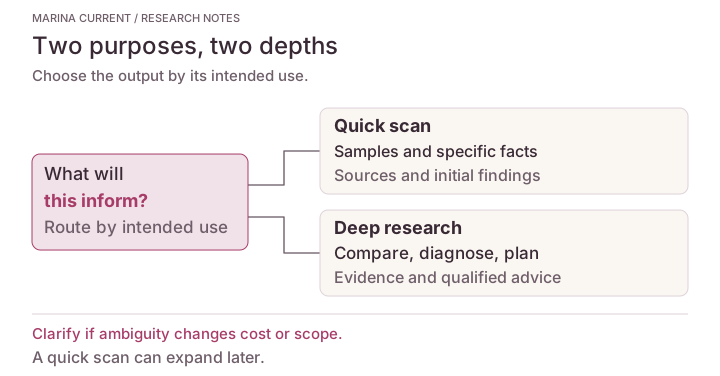
When clarification is needed, the system explains the uses of the two outputs and accepts an answer in the user’s own words. “I need examples for this afternoon’s creative meeting” already establishes enough scope. The user should not have to choose a tool name or confirm the same choice again.
This design makes the system responsible for interpreting intent. Looking back at the tradeoff, I would rather leave a quick scan open to later expansion than cover every possible need with a full study. Someone who explicitly asks for deep analysis should not first receive a sample list and then have to explain the request again.
When a quick scan expands, who owns the existing evidence?
Two flows create another question: after seeing the samples, the user decides to investigate further. What happens to the work already done?
I made deeper research responsible for the overall question, evidence checks and final report. Specialist capabilities handle their own data collection and calculations. A quick scan can hand over usable raw material, but does not launch another full study independently or paste its earlier report into the new one.
The purpose is to avoid two flows collecting the same evidence and interpreting it separately, leaving someone else to decide which conclusion to trust.
Evidence has to be checked against the new question. In this synthetic example, the first collection covers US ads and the next request concerns the Japanese market. The old ads can remain as creative references, but the market comparison needs new evidence.
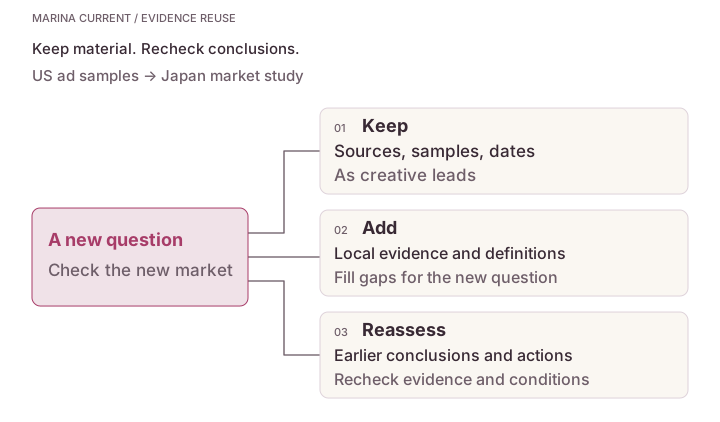
The handoff rules therefore retain sources, raw material and observation details. The report uses only facts it actually relies on and keeps a way to check them. When structured results are available, it should not copy an already rounded value back out of an earlier written summary.
This adds preparation work, but makes it possible to decide whether material still applies. If all that survives is “competitors prefer outcome-led ads,” it is hard to know whether that statement should stay after the market changes.
Scope must constrain the final report too
If the entry point distinguishes a quick scan from deeper research but both still fill out the same long template, the decision has not reached the actual output.
I connected research priorities to report structure. Creative research needs to explain what mechanism could be reused, the supporting evidence and its conditions. Search and visibility research needs action items that state priority, why to act now and how to validate the result. Each section should answer a specific question; optional sections without supporting material can be omitted.
These requirements also went into generation and validation. A report type that does not match the closing plan, unfilled template placeholders, or a table of contents still linking to a removed section cannot be treated as a finished deliverable. The corresponding counterexamples went into tests.
The distinction in research scope therefore affects accepted inputs, generated sections and rejected outputs, not just prompt wording. Templates remain reusable, but filling every section cannot stand in for completing the research.
Collecting more evidence cannot answer every question
Another constraint is how strong a conclusion the evidence can support.
Public ads can help identify opening hooks, selling points and landing-page practices. They usually do not reveal competitors’ actual conversion data. Collecting dozens more similar ads can improve understanding of the creative, but does not establish which one converts best.
In this implementation, I carried comparable limits into data and output checks. For search and AI-visibility research, for example, a preliminary scan with limited samples must not produce an unqualified formal score. Data with different periods, markets or measurement conditions must not be presented as a direct ranking or trend. Tests retained inputs and reports that should fail these checks.
Those checks catch explicit comparison errors. An explanation of why a creative works and whether it is worth adapting still has to be made in the analysis. Public observations can suggest a direction for a small creative experiment. The same evidence is insufficient for a major budget change.
What the delivery left behind
The submissions connected routing, research handoffs, report structure, generation checks and tests. A later change to scope now calls for checking which collection tasks, sections and validations it affects.
For further iteration, I would first look at what users ask to have redone after receiving a result, rather than one average generation time across every report. A missing source may require a collection fix. A request to redo the comparison for another market may mean the initial scope decision was wrong. That distinction changes what should be improved next.
This article draws on historical team submissions I contributed to. AI assisted implementation. Both figures use synthetic scenarios to explain the rules. Delivery included rules, code and tests; actual usage records have not yet established cost savings or adoption.
相关工作与笔记
看相关的报告校验案例,并用合成样例试试检查器。
研究范围明确后,还要判断数据能支持什么结论。这篇记录另一份数据交付。